



Please Leave Us A Message
Privacy statement: Your privacy is very important to Us. Our company promises not to disclose your personal information to any external company with out your explicit permission.

Short answer: they were built on different assumptions, and almost none of them say which. Published clearance figures for the same material differ up to threefold, and for aluminium the two best-known sources disagree on the direction. Overlap figures differ more than tenfold. If you have ever asked why do slitter knife clearance charts disagree: a percentage of thickness is not a setting, only a guess that becomes one on an arbor.
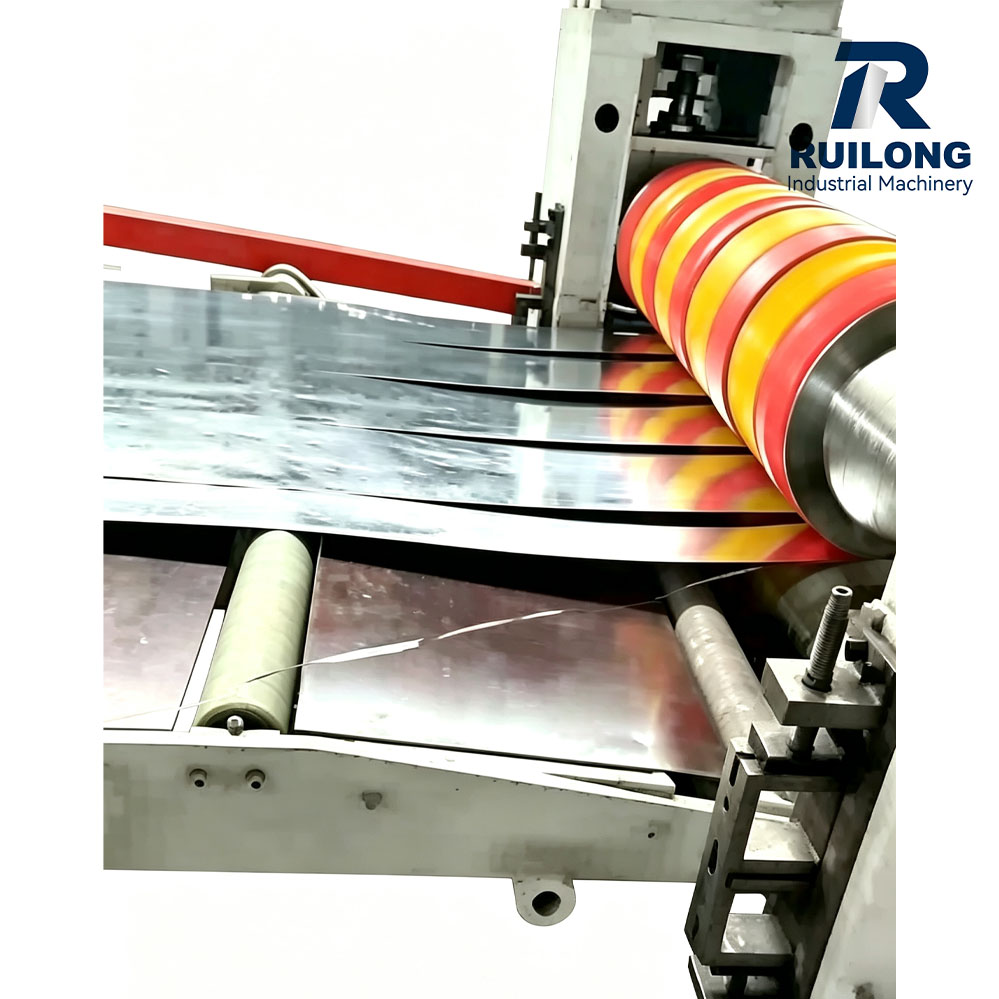
Not because anyone measured badly — because two different variables are published under one name. Horizontal clearance is the side gap between the knife faces at a cut; vertical overlap is the depth the upper edge passes below the lower one. Many charts list one, some the other, a few blend both. Four problems sit on top.
A clearance percentage that ignores UTS is not a specification. Annealed 304 sits near 515 MPa; full-hard 301 runs past 1,200 MPa. Both are "stainless steel", and need clearances about two to one apart.
Aluminium is where the sources invert. Maxwell Slitters (maxwellslitters.com) publishes 3–6% of thickness for dead-soft aluminium and 6–10% for harder alloys — the tightest of any coil material, because ductile metal at a wide gap folds and smears instead of fracturing. slitter.ai publishes 6–10% for aluminium: Maxwell's alloy number as the material number. Both are right about the coil they held; neither says which.
On 0.3 mm foil, 8% of thickness is 24 microns — smaller than the tolerance stack it must survive. Maxwell's own arithmetic: twenty spacers each 5 microns out one way accumulate to 100 microns, more than the thin-gauge clearance budget. A knife held to ±0.01 mm is fine on 3 mm plate and useless on foil. Above 3 mm the relationship weakens again, and the correct overlap can be zero or a small vertical gap, because the strip fractures before the edges meet. That is why Ruilong sizes every knife and spacer set to the job list, not to the machine.
Horizontal clearance vs vertical overlap slitting knife data is where it becomes extreme, and the cause is a definition error.
| Source | Mild / carbon | Stainless | Aluminium | Overlap basis |
| Maxwell Slitters (UTS-keyed) | CR CQ 6–10%, HR 10–14%, AHSS 14–25% | Annealed 304/430 10–14%, full-hard 301 14–25% | Soft 3–6%, hard alloy 6–10% | Absolute mm by gauge band |
| Maxtor Metal (maxtormetal.com) | CR/HR 8–12% (~10% mid) | AHSS/stainless 10–15% | Al & soft alloys 5–8% | +0.25–0.50 mm |
| Mingbai (mingbaiblade.com) | 5–10% (start 8%) | — | — | 30–50% of thickness |
| The Fabricator / Al Zelt | "10% is rarely the correct clearance" | — | — | Excess overlap drives edge wave |
Convert Mingbai's percentage and Maxwell's millimetres into one unit and the gap is threefold at 1.0 mm, more than ten to one at 2.0 mm. The reason: overlap is a depth, penetration at fracture a material behaviour. Soft ductile metal must be driven a long way in before it separates, so it needs positive overlap; high-strength material cracks early and needs almost none. Any percentage rule ignoring strength is wrong at one end.
Separating force reaches thousands of pounds at each cut; a full gang multiplies it, deflecting the arbor and opening clearance under load, where it cannot be measured. A working rule: knife thickness of three to five times the heaviest gauge you run; one chip trapped between a spacer and a knife face shifts every cut outboard of it, which is why Ruilong specifies shimless, metal-to-metal tooling. Add that much published data came from guillotine shears, not a rotary gang, and you have the mechanism behind why do slitter knife clearance charts disagree in practice.
✅ Bottom line: Clearance charts conflict because they key the number to the material name instead of tensile strength, and to thickness instead of machine stiffness.
Key it to the tensile figure on the mill certificate, then confirm it on the cut edge — in that order.
| Strip UTS | Clearance (%t) | At 1.0 mm | Overlap at 1.0 mm |
| 200–350 MPa — soft Al, Cu, HR mild | 5–8% | 0.05–0.08 mm | 0.10–0.15 mm |
| 350–550 MPa — CR CQ, HSLA 350, 430 ann. | 8–12% | 0.08–0.12 mm | 0.05–0.10 mm |
| 550–800 MPa — 304 ann., DP600, Q355 | 10–14% | 0.10–0.14 mm | 0.03–0.08 mm |
| 800–1,200 MPa — TRIP780, DP980, Q690 | 12–18% | 0.12–0.18 mm | 0–0.05 mm |
| >1,200 MPa — martensitic, UHSS | 16–25% | 0.16–0.25 mm | Zero, or a small gap |
Four rules make it usable:
After cut three, record clearance, overlap, gauge, grade and UTS on a setup sheet — next time you set from your own record, not a chart. That record is what makes a custom line worth specifying: Ruilong builds to the gauge range and grade mix you actually run, and ships the matched OEM/ODM knife, spacer and stripper-ring set as one package.
✅ Bottom line: Set clearance from the mill certificate tensile figure, then set the shallowest overlap that separates the strip, in that order.
Q: Why do slitter knife clearance charts disagree, and is the 10% rule usable at all? A: Each was written for a specific temper, gauge range and machine stiffness, and none state it. The 10% rule is a fallback for mid-gauge carbon steel only. Al Zelt's assessment in The Fabricator is blunt: on a few thicknesses and types 10% happens to work, and it is rarely correct elsewhere. Use it to start the line, then replace it with the number Ruilong ships with every slitting head.
Q: Horizontal clearance vs vertical overlap slitting knife — which do I adjust first? A: Horizontal, always. It controls where the cracks start and whether they meet cleanly; overlap only controls when the strip separates. Wrong clearance either way makes the strip resist separating, and adding overlap turns one error into two.
Q: Can one knife and spacer set cover my whole job list? A: Not across a wide gauge or grade spread: a stack built for 0.3 mm foil cannot hold a 3 mm clearance budget, and 3 mm knives are too thick to hold foil tolerance. As a Slitting Line manufacturer in China, Tai'an Ruilong Machinery Co., Ltd. supplies shimless metal-to-metal tooling and 508–610, 730 and 760 mm reducer sleeves, so a custom setup repeats identically, no separate tooling supplier to chase.
Send Ruilong your gauge range, grades, mill-certificate tensile figures and target number of mults. The engineering team at Tai'an Ruilong Machinery Co., Ltd. returns a setup sheet with the correct knife clearance percentage for slitting mild steel on your carbon jobs, the matching knife, spacer and stripper-ring package, and a factory-direct quote, free and without obligation.

October 25, 2026
October 24, 2026
Email to this supplier
October 25, 2026
October 24, 2026
Privacy statement: Your privacy is very important to Us. Our company promises not to disclose your personal information to any external company with out your explicit permission.
Fill in more information so that we can get in touch with you faster
Privacy statement: Your privacy is very important to Us. Our company promises not to disclose your personal information to any external company with out your explicit permission.