



Please Leave Us A Message
Privacy statement: Your privacy is very important to Us. Our company promises not to disclose your personal information to any external company with out your explicit permission.

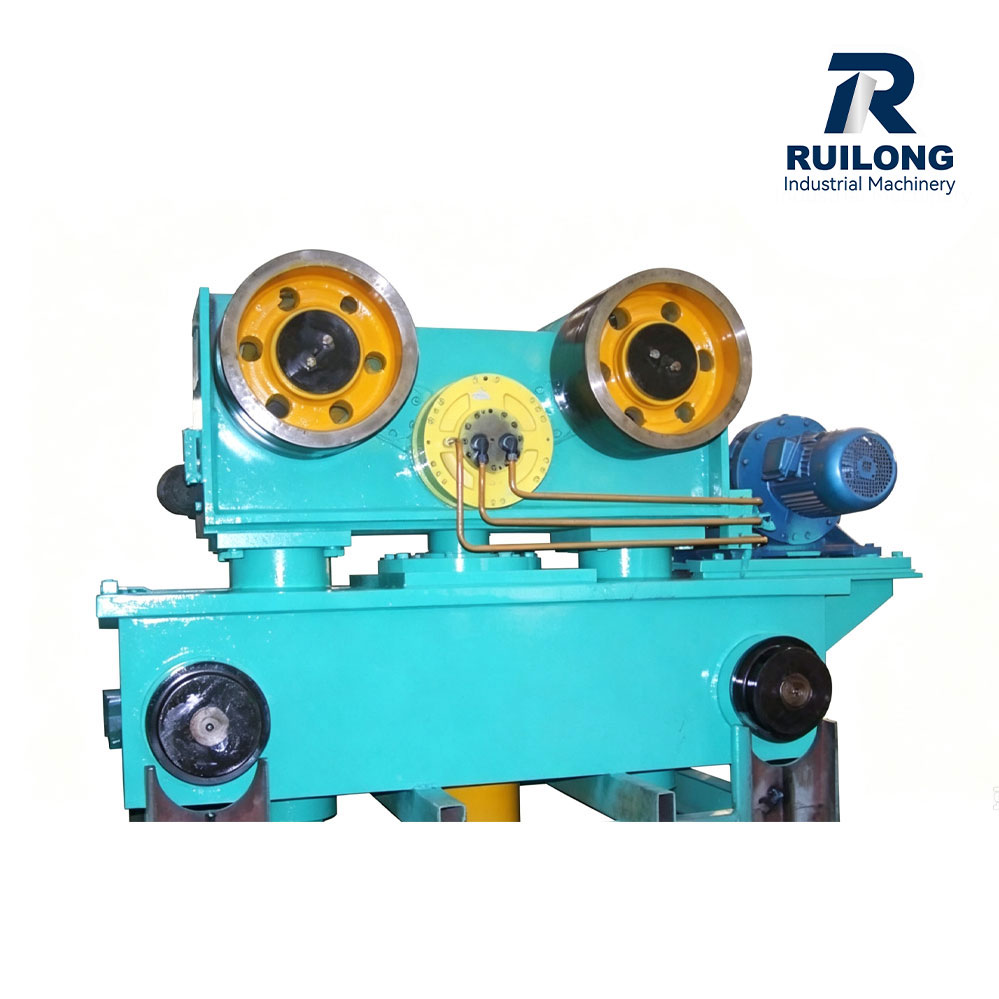
Three floors, only one of which is about the knives. The classic account of rotary slitting identifies the mechanism behind the second: the force couple from the cutting pressure and side clearance, plus the compressive forces at penetration, act in opposite directions at the two edges of a strand, and if unrestrained they bow the strip laterally. That is the origin of camber in narrow strip, and it is a mechanics problem, not a tooling problem.
| Floor | Physical origin | Binds when | What to ask a supplier |
| Tooling width | Stripper rings, spacers and separator discs all have a minimum axial thickness | Below roughly 1 mm | Minimum lane width with your ring and disc sizes |
| Twist resistance | The cutting force couple bows the strand; resistance falls with width | Above roughly 1 mm | Camber figure at your narrowest width, in mm per metre |
| Recoiler tension | Tension stress is force divided by the strip cross-section, so it climbs as the strip narrows | Any narrow strip at speed | Minimum controllable tension and separator disc thickness |
The cross-section matters more than either dimension alone. Tension stress is tension force divided by width times thickness, so halving the strip width doubles the stress at the same pull — which is why narrow strip tears on lines that handle the same tonnage in wide strip without trouble. It is also why the usual remedy for narrow strip is not a better knife but a lighter tension range and more separator discs, and why Ruilong specifies the recoiler section before the slitter head on narrow-strip enquiries.
✅ Bottom line: narrow strip is limited by the recoiler and by camber before it is limited by the tooling, so ask for the camber figure at the narrowest width, not just the width.
They separate cleanly, and the spread is far wider than any single brochure figure suggests. The table below is compiled from builders' published capabilities, with the gauge band printed next to each claim.
| Thickness band | Arbor diameter as published | Minimum finished width | Maximum strands |
| 0.2–1.5 mm | Ø140–160 mm shaft, Ø280 mm knives | 12 mm standard; under 10 mm needs dedicated tooling | 15–30 |
| 0.3–3.0 mm | Ø140–200 mm | 22 mm | 10–22 |
| 2.0–6.0 mm | Ø300–400 mm | 50–70 mm with standard arbors | Not quoted |
| 0.5–2.0 mm | Loop pit plus tension-controlled recoiler | Down to 20 mm; below it camber becomes hard to control | Not quoted |
Two things are worth noticing in that table. First, the minimum width moves by a factor of roughly five across the thickness range, so a builder quoting "12 mm" without saying at what gauge is quoting a figure from the thin end of its range. The minimum slit width for 3mm hot rolled steel coil sits at the heavy end of that spread and is the row most often misread as a general capability. Second, published arbor diameters for overlapping bands differ by two to three times between builders, which is a stiffness and deflection question rather than a capability one — the diameter is chosen to hold deflection down as separating force rises with the square of thickness.
Reading a narrow-strip claim properly means asking four questions Ruilong answers on every quotation:
✅ Bottom line: ask for minimum width, camber and burr at one stated gauge, and treat any claim missing two of the three as a marketing number rather than a capability.
Q: How narrow can a slitting line cut steel strip on general-purpose equipment? A: Around 22 mm on a 0.3–3.0 mm line and 12 mm on a dedicated 0.2–1.5 mm narrow-strip line. Push below 10 mm and you are into dedicated tooling and a specific technical assessment, not a catalogue configuration.
Q: What is a realistic minimum slit width for 3mm hot rolled steel coil? A: Roughly 50–70 mm on standard arbors, and Ruilong will confirm it against your grade before quoting. The binding constraint at that gauge is not the tooling — it is camber, because the cutting force couple scales with thickness while the strand's resistance falls with width.
Q: How does slitter arbor diameter selection for strip thickness range affect narrow-strip work? A: Diameter is chosen for stiffness, since separating force rises with the square of thickness. Light-gauge lines run Ø140–200 mm and heavy lines Ø300–400 mm, and undersizing the arbor shows up as width drift between the first and last strip in the gang.
Send Ruilong your thinnest gauge, narrowest target width and downstream process. As a slitting line manufacturer in China, Tai'an Ruilong Machinery Co., Ltd. returns a custom capability table with width, camber and burr at each gauge you run, specifies the OEM/ODM recoiler and separator arrangement to suit it, and quotes factory-direct — one supplier accountable for the narrowest strip on your order book.

October 25, 2026
October 24, 2026
Email to this supplier
October 25, 2026
October 24, 2026
Privacy statement: Your privacy is very important to Us. Our company promises not to disclose your personal information to any external company with out your explicit permission.
Fill in more information so that we can get in touch with you faster
Privacy statement: Your privacy is very important to Us. Our company promises not to disclose your personal information to any external company with out your explicit permission.