



Please Leave Us A Message
Privacy statement: Your privacy is very important to Us. Our company promises not to disclose your personal information to any external company with out your explicit permission.

Short answer: read clearance in millimetres per side, keyed to tensile strength rather than to the grade name on the tag. The table below gives starting windows for eleven material families across four gauges, which is what you actually need standing at the arbor with a feeler gauge. Every slitter knife clearance chart by material and thickness also carries conditions nobody prints — knife outside diameter, assembled runout, regrind state and bearing condition all move the number after you set it. The version below is the one Ruilong issues with every line, and section 2 lists the conditions attached to it.
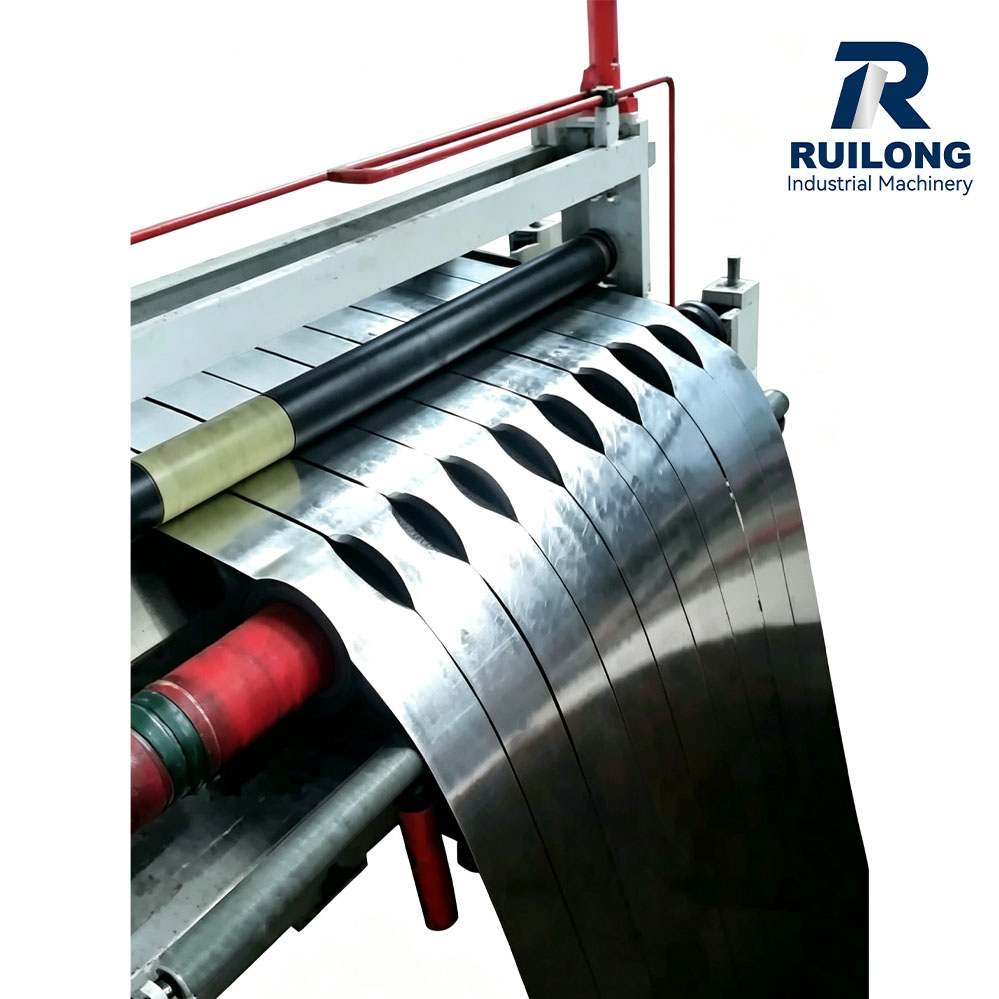
Take the band midpoint for your material's tensile strength, convert it to millimetres, then verify it physically. The conversion is simple: total gap = percentage ÷ 100 × gauge in mm. Values below are the total gap between the two knife faces — a common source of error, since some tooling houses quote per side and their numbers therefore read at half these figures. Clearance tracks strength because stronger material cracks earlier in the cut, so its fracture faces need more room to pass each other cleanly.
| Material family | Typical UTS (MPa) | Clearance, % of t | 0.5 mm | 1.0 mm | 2.0 mm | 3.0 mm |
| Annealed low-carbon CR (DC01, SPCC, A1008 CS) | 270–330 | 6–10% | 0.040 | 0.080 | 0.160 | 0.240 |
| Temper-rolled / full-hard CR (full-hard SPCC, T4–T5 tinplate) | 380–520 | 8–12% | 0.050 | 0.100 | 0.200 | 0.300 |
| Hot-rolled pickled and oiled (SPHC, A1011 HRPO) | 340–440 | 8–12% | 0.050 | 0.100 | 0.200 | 0.300 |
| Hot-dip galvanized / Galvalume (DX51D, S350GD) | 300–500 | 8–13% | 0.053 | 0.105 | 0.210 | 0.315 |
| Ferritic stainless (430, 409, 439) | 450–550 | 8–12% | 0.050 | 0.100 | 0.200 | 0.300 |
| Austenitic stainless, annealed (304, 316L, 321) | 520–620 | 10–14% | 0.060 | 0.120 | 0.240 | 0.360 |
| Annealed aluminium (1050-O, 1100-O, 3003-O) | 90–150 | 4–7% | 0.028 | 0.055 | 0.110 | 0.165 |
| Strain-hardened / heat-treated aluminium (5052-H32, 6061-T6) | 230–320 | 6–10% | 0.040 | 0.080 | 0.160 | 0.240 |
| Copper and brass (C11000 annealed, C26000 H02) | 220–330 | 6–10% | 0.040 | 0.080 | 0.160 | 0.240 |
| Electrical steel (M470-50A NGO, CGO grades) | 450–560 | 7–10% | 0.043 | 0.085 | 0.170 | 0.255 |
| AHSS / high-strength low-alloy (DP600, TRIP780, Q690) | 600–1,000 | 12–18% | 0.075 | 0.150 | 0.300 | 0.450 |
Four rows deserve a note, because the number alone hides the thing that will bite you:
Rows two, three and five genuinely share a window; they differ in burr behaviour and knife wear rather than in the setting, which is why Ruilong lists them separately. Stripped to practice, the knife clearance for 2mm mild Steel Slitting Line duty is one figure — 0.16 mm total gap — recorded once per job rather than argued over every coil.
✅ Bottom line: convert tensile strength to a millimetre gap, set the band midpoint, then validate against a cross-section before you commit a coil to it.
Below roughly 0.3 mm, above roughly 3 mm, and anywhere the machine's tolerances exceed the clearance you are trying to hold. Every slitter knife clearance chart by material and thickness assumes the percentage scales cleanly with gauge, but the accuracy of the tooling that delivers it does not.
| Regime | Gauge | Why the percentage fails | Use instead |
| Thin foil and light gauge | below 0.3 mm | 8% of 0.15 mm is 0.012 mm — smaller than the ±0.005 mm knife thickness tolerance plus the ±0.005 mm spacer tolerance it sits on | shimless matched tooling; judge the burnish band under 10× rather than trusting a shim figure |
| Working range | 0.3–3.0 mm | it does not; this is where the rule earns its keep | band midpoint, ±2 percentage points |
| Heavy plate | above 3.0 mm | 12% of 6 mm is 0.72 mm of total gap, more than most arbor assemblies hold under cutting load | absolute figures from a shear-force and tool-load check, tapering toward a floor near 0.4–0.5 mm |
Three millimetres is the practical ceiling: the slitting knife clearance percentage for 3mm carbon steel still tracks within two points of what the machine delivers, whereas anything heavier has to be specified as an absolute figure.
Five conditions decide whether the number you dialled is the number you get — and every line Ruilong commissions is verified against all five before it leaves the shop:
✅ Bottom line: below 0.3 mm and above 3 mm the percentage rule collapses, so those two regimes must be specified in absolute millimetres.
Q: Which slitter knife clearance chart by material and thickness is worth trusting? A: One that states four things — the tensile range it was built for, the gauge range, the knife outside diameter, and whether the figure is total gap or per side. A table stating none of those is a starting guess, and treating it as a specification is how edge trouble gets blamed on the steel. Ruilong issues its own chart with each line and updates it whenever the tooling set changes.
Q: What is the knife clearance for 2mm mild steel Slitting Line duty? A: Around 0.16 mm total gap, from the 6–10% window for annealed low-carbon cold-rolled. Set the midpoint, run two or three metres at reduced speed, read the edge under 10×, then write the result into a setup sheet so nobody has to derive it twice.
Q: Does the slitting knife clearance percentage for 3mm carbon steel still hold above 3 mm? A: Up to 3 mm, yes, to within a couple of points. Beyond it the percentage outgrows what the arbor can hold under load, so Tai'an Ruilong Machinery Co., Ltd. specifies heavy jobs in absolute millimetres derived from a shear-force and tool-load check.
Send Ruilong your grades, gauge range and mill-certificate tensile figures. As a slitting line manufacturer in China, Tai'an Ruilong Machinery Co., Ltd. returns a custom chart covering every grade you run, ships the matched OEM/ODM knife, spacer and stripper-ring package as one set, and quotes factory-direct — one tooling supplier instead of three, with the regrind limits stated up front.

October 25, 2026
October 24, 2026
Email to this supplier
October 25, 2026
October 24, 2026
Privacy statement: Your privacy is very important to Us. Our company promises not to disclose your personal information to any external company with out your explicit permission.
Fill in more information so that we can get in touch with you faster
Privacy statement: Your privacy is very important to Us. Our company promises not to disclose your personal information to any external company with out your explicit permission.