



Please Leave Us A Message
Privacy statement: Your privacy is very important to Us. Our company promises not to disclose your personal information to any external company with out your explicit permission.

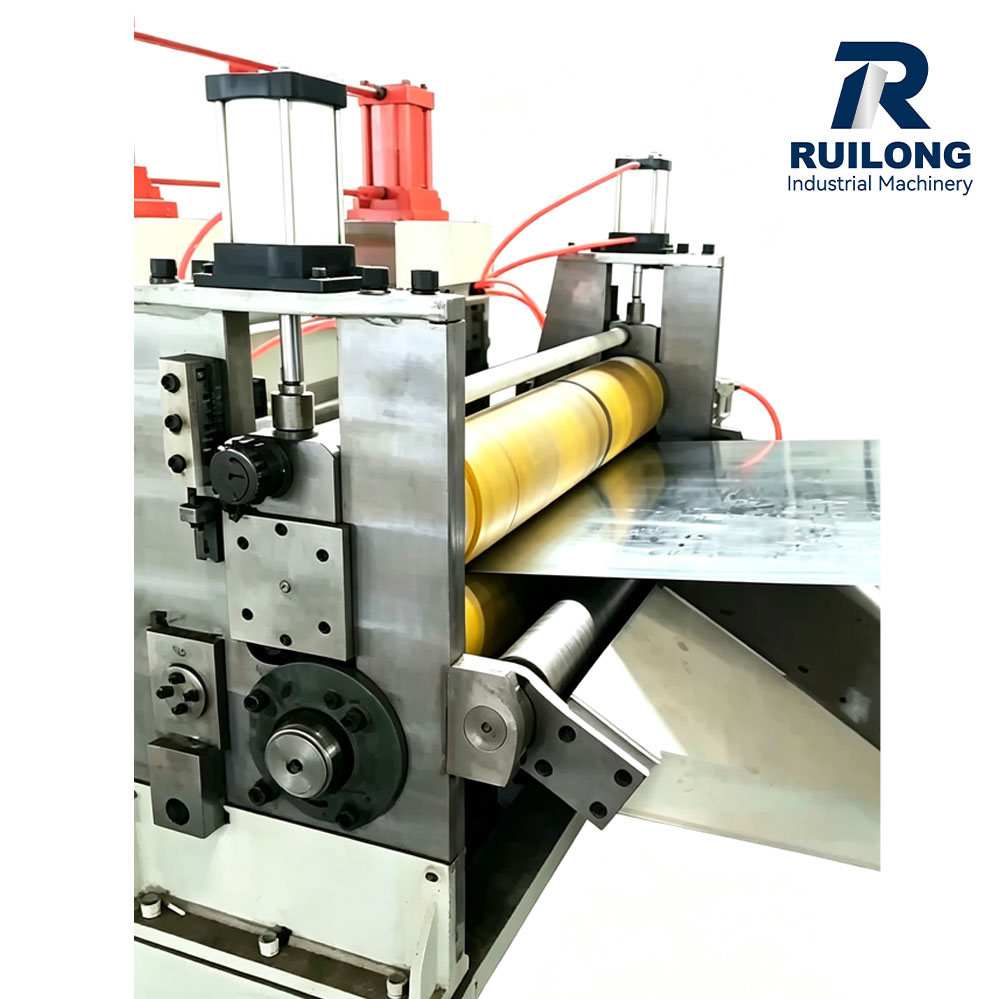
The tooling stack, not the machine. Every published answer to what slit width tolerance can a slitting line hold is really a statement about the spacers between the knives. They are stacked in series, so the width of any lane is the sum of everything between the knives either side of it, and the errors accumulate down the arbor in one direction.
| Capability band | Width tolerance | Spacer width tolerance needed | Assembled arbor runout | Typical work |
| General service | ±0.10–0.20 mm | ±0.010 mm | ≤0.02 mm | building panel, sheeting, general fabrication |
| Precision | ±0.05 mm | ±0.005 mm | ≤0.010 mm | tube mill feed, roll forming, appliance panels |
| High precision | ±0.02–0.03 mm | ±0.002 mm, matched and documented | ≤0.005 mm | battery foil feed, electrical laminations, fine blanking feed |
Two more constraints sit under those numbers. Bore fit decides whether a spacer sits true on the arbor — H6/h5 on 75 mm and 100 mm arbors leaves about 0.010–0.012 mm of radial clearance, and H7/h6 on 150 mm leaves about 0.015 mm, any of which converts directly into knife tilt. Face quality decides whether the stack stays seated: precision spacers are ground to 0.002 mm of flatness and parallelism with a surface around Ra 0.2 µm, against 0.005 mm and Ra 0.4 µm for standard grade.
The arithmetic explains why the cost of accuracy rises steeply. Take twenty spacers:
| Spacer width tolerance | Worst-case stack error | RSS estimate | What it supports |
| ±0.020 mm (common import grade) | ±0.40 mm | ±0.089 mm | nothing that anyone wants to sell |
| ±0.010 mm | ±0.20 mm | ±0.045 mm | general service only |
| ±0.005 mm | ±0.10 mm | ±0.022 mm | precision band |
| ±0.002 mm, matched | ±0.040 mm | ±0.009 mm | high precision band |
Worst-case is the sum of all twenty errors and protects against hard limits such as knife collision. The root-sum-square estimate assumes the deviations are independent, which is what actually happens with ground spacers — and the gap between the two columns is why shops that only ever audit worst-case conclude they cannot improve. It is also why Ruilong grades every precision set by measured thickness rather than nominal size.
✅ Bottom line: advertise ±0.10 mm, build to ±0.05 mm with ±0.005 mm spacers, and treat anything tighter as a matched-set problem.
Buy accuracy where it is cheapest — in the tooling and the setup procedure, not in the machine. Ask anyone selling upgrades how to improve strip width accuracy on slitting line runs and the answer usually arrives expensive; in practice nearly all of it lives in the seven controls below, and only one concerns the slitter itself.
The slitting line width tolerance for 1mm cold rolled steel that most service centres can safely quote is ±0.10 mm, dropping to ±0.05 mm once matched sets and a written torque procedure are in place. Below that, the answer to how to improve strip width accuracy on slitting line stops being about spindle quality at all, because the limiting item is document control: which spacer sat where, at what measured thickness, torqued in what order. Anything below that has to be specified as a documented tooling package, which is why Ruilong ships measured-thickness certificates with precision sets rather than nominal sizes.
✅ Bottom line: seven setup controls move width accuracy further than any machine upgrade, and six of them cost nothing but discipline.
Q: What slit width tolerance can a slitting line hold straight out of the crate? A: That figures depend on the tooling grade specified with the line, not on the machine. A general-purpose line with standard spacers lands around ±0.10–0.15 mm, and a stiffer frame does nothing until the stack-up is addressed — Ruilong audits spacer sets before quoting any capability figure.
Q: What slitting line width tolerance for 1mm cold rolled steel should I quote a customer? A: Quote ±0.10 mm for commercial work and ±0.05 mm only with matched spacer data and post-torque runout figures behind it. State both on the order together with where the measurement is taken, which is the format Ruilong uses on its outgoing inspection records.
Q: Why does a lane drift wider over the length of one coil? A: Thermal growth is the usual cause. Arbors and knife bodies warm up from cutting heat during the first few hundred metres, and the shift compounds outward from the locating bearing until the machine reaches a steady state.
Send Ruilong your mult widths, gauges and target tolerance. As a slitting line manufacturer in China, Tai'an Ruilong Machinery Co., Ltd. supplies custom lines with matched spacer sets, measured-thickness certificates and a written torque procedure — one OEM/ODM tooling supplier, quoted factory-direct with the accuracy you can hold stated in writing.

October 25, 2026
October 24, 2026
Email to this supplier
October 25, 2026
October 24, 2026
Privacy statement: Your privacy is very important to Us. Our company promises not to disclose your personal information to any external company with out your explicit permission.
Fill in more information so that we can get in touch with you faster
Privacy statement: Your privacy is very important to Us. Our company promises not to disclose your personal information to any external company with out your explicit permission.